A Match Has a Shape Before It Has a Score
Watch a team game through position and movement to spot how space opens, roles shift, and pressure changes before the scoreline explains the result.
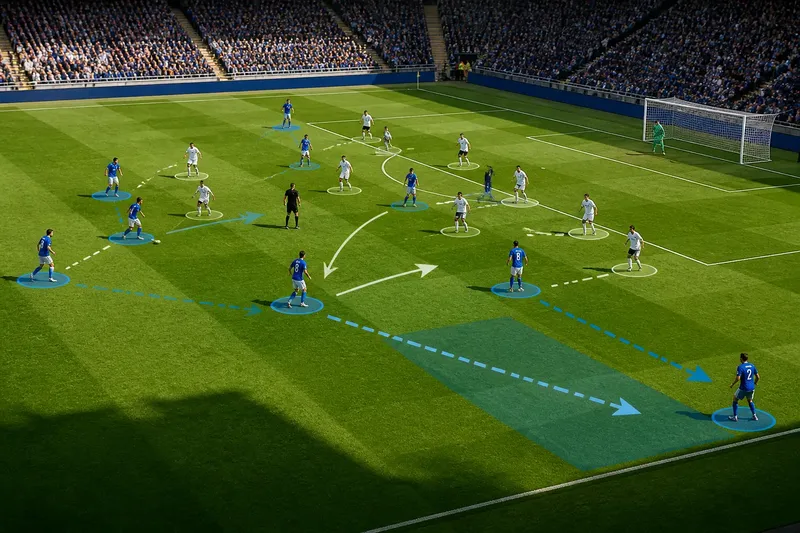
The most common mistake when learning to watch a team game is keeping your eyes on the ball and waiting for the score to tell you what matters. That habit hides the match’s changing shape: who has room, who is being drawn out of position, and which player is making the next action possible. To watch a team game through position and movement, begin with the spaces around the play.
Choose one area before the next attack begins
Settle on a view that includes the ball carrier and several teammates nearby. At a live match, a seat higher up often makes spacing easier to see; on a broadcast, a wide camera angle is more useful than a close-up. You do not need to follow every player. Pick one corridor, flank, or patch of central space and notice who occupies it.
First, look at the team in possession. Do its players stand in a line, spread out, or gather near the ball? Then check the defending team: are they compact around the middle, stretched across the field, or stepping forward to challenge? These are observations, not judgments. The same arrangement can be sensible in one moment and vulnerable in another.
Trace the space around the ball
Follow the ball for a moment, then deliberately look away from it. Notice the gap the ball has left behind and the space toward which it is moving. A pass can matter because it reaches a teammate, but it can also pull a defender away and open a lane for someone else.
Watch how nearby players respond after a pass. Does the receiver get an option ahead, behind, or to either side? Does a teammate move into open space, or does the defense close it before the ball arrives? In basketball, this may mean watching the lane beside the ball handler; in soccer, it may mean noticing a run beyond the player receiving a pass. The details differ, but the question is the same: what space is available now that was not available a moment ago?
Read movement as a change in role
Positions give you a starting map, not a permanent job description. A player listed or introduced as a defender may step forward to support an attack, while a forward may drop back to help the team keep possession. Watch the player’s next movement before deciding what role they are taking on.
Look especially at the players just outside the immediate contest. One may hold a position to stretch the defense; another may move closer to offer a safe pass. A third may stay behind the ball so the team has cover if possession changes. These choices can make a play look crowded near the ball while actually creating options elsewhere.
Say you are watching a soccer match and the right winger receives the ball near the sideline. Imagine the fullback overlaps, while a central midfielder stays behind them. The expected observable result is that the defender must choose whether to follow the overlapping player or protect the route inside; you can then watch which space becomes easier for the attack to use. The point is not to predict a goal, but to see how movement changes the choices available.
Notice when the team changes from attack to defense
A turnover makes the shape shift quickly. Instead of following only the player who won the ball, scan the nearby teammates: who moves to challenge, who drops toward the goal or basket, and who protects the center? The first few movements show whether the team is trying to regain possession immediately or retreat into a more organized shape.
Then watch the team that lost the ball. Some players may press the new carrier, while others recover into defensive positions. If those responses are delayed or scattered, the opponent may find room to advance. If they are coordinated, the new possession may be forced toward the boundary or into a less useful area.
Do not treat a retreat as passivity or a forward step as automatic aggression. A team may give up nearby space to protect a more dangerous route, or advance to make the playing area feel smaller. Read the movement in relation to the space the team is trying to protect or access.
Use these questions to make the pattern clearer
What does width mean in a team game?
Width means using space across the playing area rather than gathering everyone around the ball. Spread-out players can make defenders cover more ground, while a compact shape may help a team protect the center. Watch whether the wide players are available for a pass or simply holding their positions.
Why do players move away from the ball?
A player away from the ball can draw an opponent, create a passing option, or leave room for a teammate to move into. The movement may be useful even if the player never receives the pass. Check what changes in the space they leave and in the space they approach.
How can I tell whether a team is pressing?
Look for several defenders moving toward the ball carrier or nearby passing options, rather than one player chasing alone. Notice whether teammates behind the first challenger step forward to limit easy outlets. If the carrier is hurried into a difficult pass or toward the sideline, the pressure is shaping the available choices.
Should I watch the ball or the players without it?
Alternate between them. Follow the ball to understand the immediate contest, then scan the players around it to see who is creating or closing space. Watching only off-ball movement can make you lose the sequence; watching only the ball can hide why the sequence develops as it does.
Keep a simple viewing routine
Use the same order for a few possessions so you can notice patterns without trying to decode everything at once:
- Before possession settles: Find the broad shape of both teams and note which areas look crowded or open.
- As the ball moves: Track one nearby player and see whether they offer support, make a run, or draw a defender away.
- After a pass: Look at the receiver’s options and check whether the defense shifts with the ball.
- At a turnover: Watch the first movements from both teams: challenge, retreat, cover, or spread out.
- When play pauses: Reset your view and choose a different area to follow, such as the space behind the defense.
For instance, imagine you are watching a basketball possession and the ball moves from the top of the court to a player on the wing. You follow the nearest defender, then notice a teammate cut toward the basket as another defender turns to help. The expected observable result is a change in the passing lane or a defender’s assignment, whether or not the cutter receives the ball. That gives you something specific to watch on the next possession.
Let the score answer a different question
The score tells you which team has converted more of its opportunities so far. It does not show every useful movement that made an opportunity possible, nor every defensive adjustment that prevented one. Once you can follow position and movement, the score becomes a result to interpret rather than the only story available.
Try watching a short stretch with one question in mind: which team is making the other team move to cover space? Then return to the scoreline and see whether it reflects that stretch, or whether an earlier moment still weighs on the result. Watching a team game through position and movement this way gives you a clearer sense of how the match is unfolding, even before the next point changes the numbers.